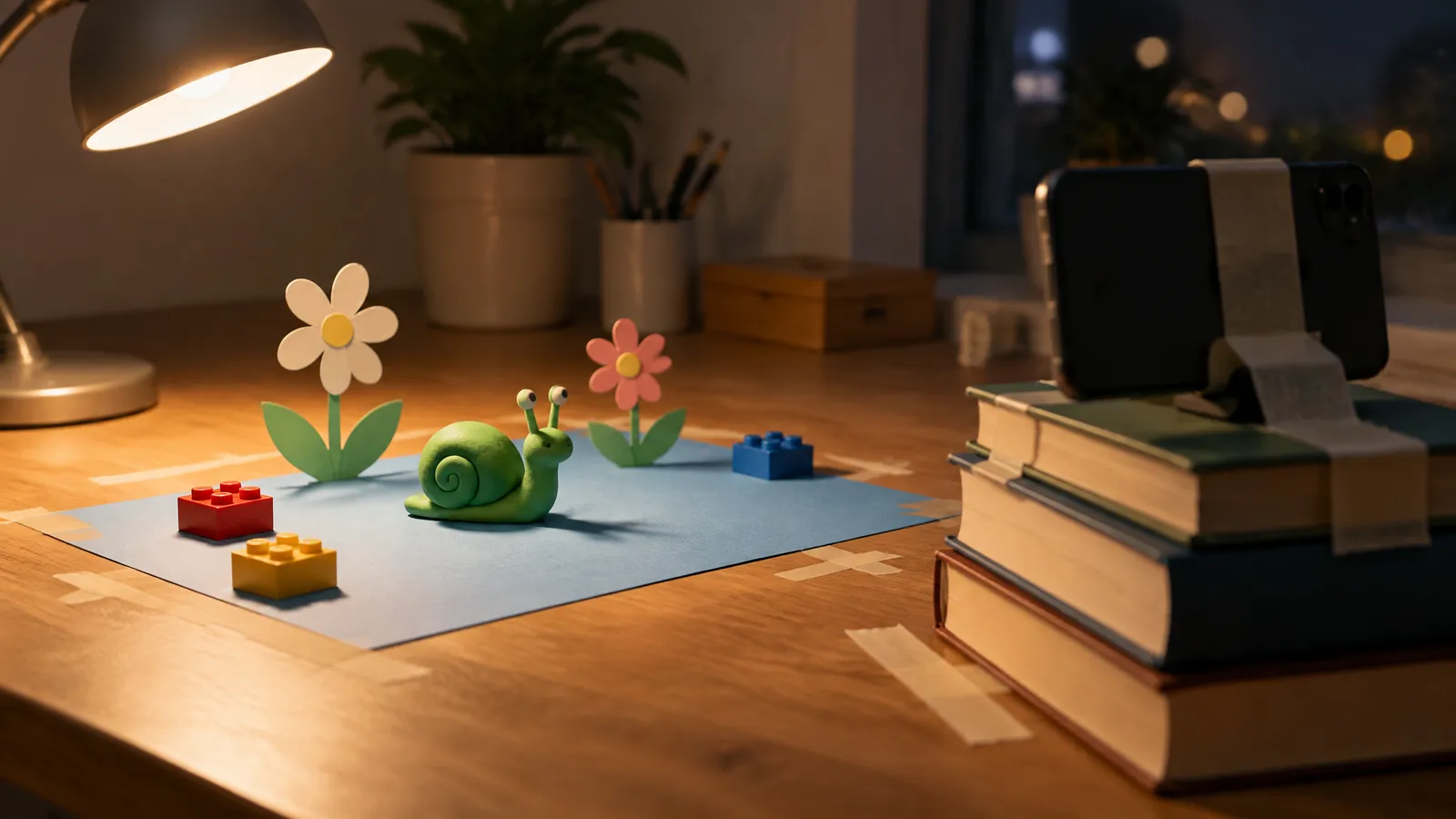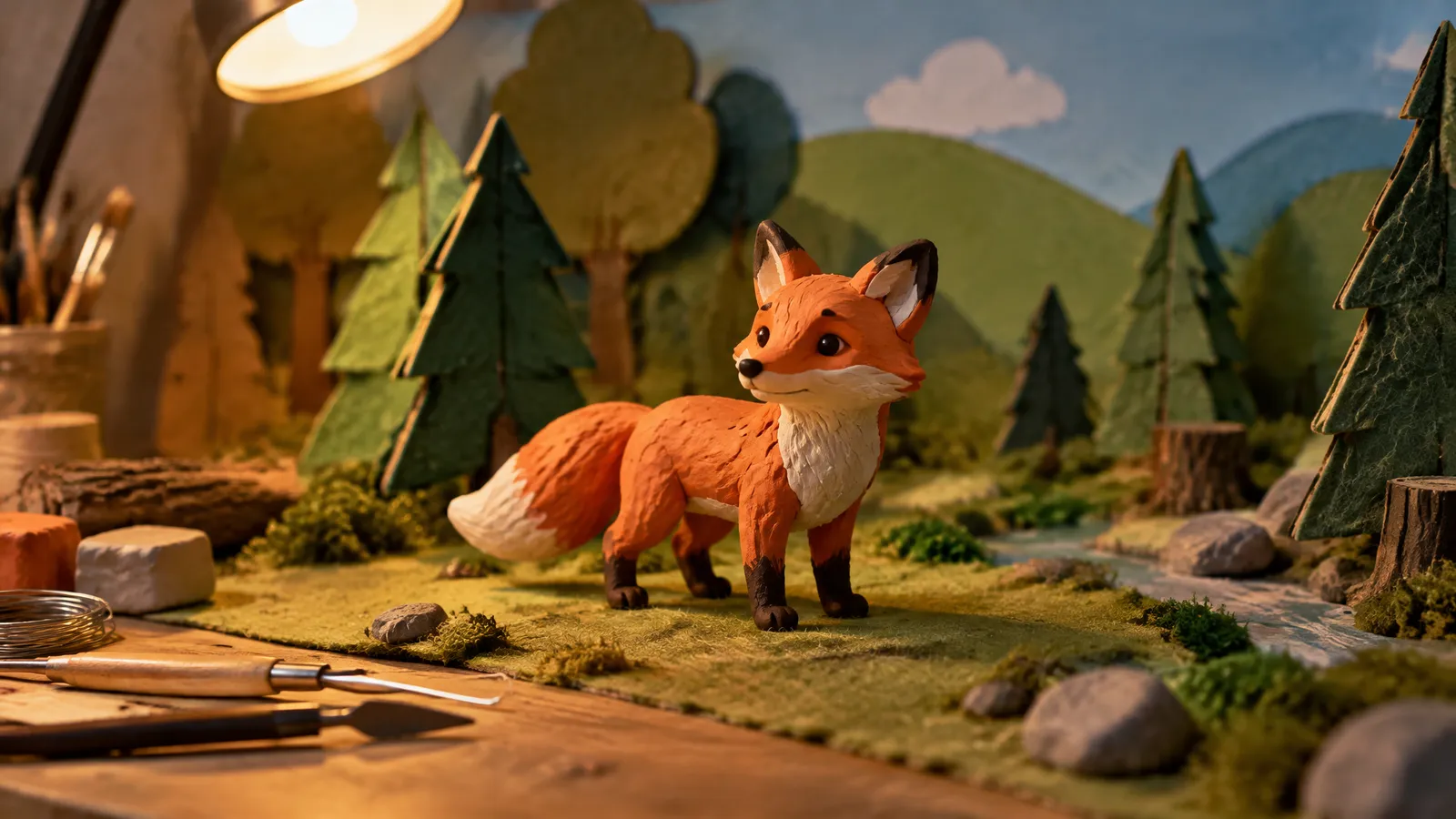
Claymation, also called clay animation, is stop motion made with soft clay figures. You pose a figure, take one photo, move it a tiny bit and take the next. Play the photos back quickly and the clay seems to move on its own.
Wallace & Gromit, Chicken Run and Gumby are all claymation. This guide explains how claymation is made and which famous films really are clay. It ends with a first project for your phone and a quick way to test the look with AI.
What is claymation?
Claymation is one of many kinds of stop-motion animation. Every moving piece is made of a soft material that bends and then stays put, usually plasticine. Characters are often sculpted around a wire skeleton called an armature, so a raised arm stays raised between photos.
The word joins "clay" and "animation". Dictionary.com says it was first recorded between 1975 and 1980 and marks it as a trademark. The American animator Will Vinton made a 1978 documentary called Claymation and later trademarked the term. You will also see "clay animation" and "plasticine animation". All three mean the same thing.
Clay on film is much older than the word:
- 1897: William Harbutt, an art teacher in Bath, England, created Plasticine because he wanted a clay that would not dry out. It became the favorite material of clay animators.
- 1908: The Sculptor's Nightmare showed clay busts that blink, speak and turn their heads.
- 1926: Long Live the Bull by Joseph Sunn is the oldest known surviving film made mainly with claymation.
Claymation vs stop motion
Stop motion is the umbrella. It covers any film where real objects are moved in small steps between photos. Claymation is the clay branch of that family.
| Type | What gets moved | Well-known example |
|---|---|---|
| Claymation | Clay or plasticine figures | Wallace & Gromit, Chicken Run |
| Puppet animation | Puppets with movable joints and swappable parts | The Nightmare Before Christmas, Coraline |
| Cutout animation | Flat shapes cut from paper, card, fabric or photos | The Adventures of Prince Achmed (1926) |
| Pixilation | Real people, posed one frame at a time | An early scene in Hôtel électrique (1908) |
| Brickfilm | Toy bricks and minifigures | Fan films shared online |
Is Coraline claymation?
Coraline (2009) is stop motion, but it is puppet animation, not classic claymation. Laika made it in Hillsboro, Oregon, with Henry Selick directing. The puppets had upper and lower face pieces made on 3D printers and swapped for each expression, allowing over 208,000 expressions. With more than 28 animators working at once, the crew finished about 90 to 100 seconds of animation a week.
There is a clay link, though. Laika grew out of Will Vinton Studios, the Portland studio behind the California Raisins ads, and took the Laika name in 2005.
Is The Nightmare Before Christmas claymation?
No. The Nightmare Before Christmas (1993), directed by Henry Selick, is puppet stop motion. The team built 227 puppets, and Jack Skellington had around 400 swappable heads.
Is The Lego Movie stop motion?
No, although it looks like it. The Lego Movie (2014) was computer animated by Animal Logic. It copies the look of brickfilms, stop-motion films made with toy bricks, and its digital figures only move the way real minifigures can.
How claymation is made
The simple version: build a figure that holds a pose, lock the camera and lights, then move, shoot and repeat.
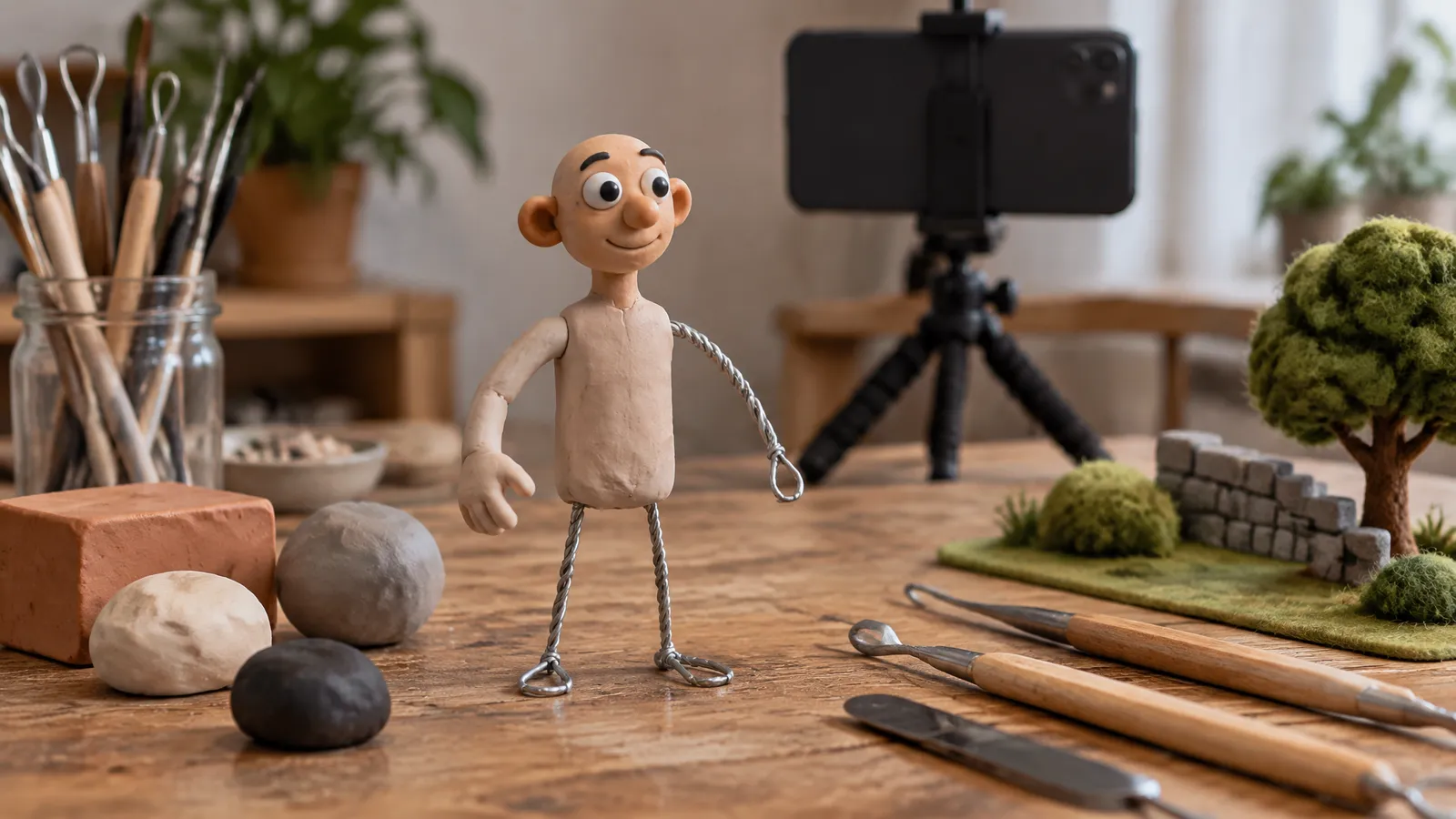
The armature. A wire skeleton sits inside the figure. It lets a limb bend and stay bent. Without it, thin clay limbs tend to droop.
The clay. Plasticine is an oil-based modelling clay. The oil does not evaporate, so the clay stays soft instead of drying hard. The catch is heat: warm clay gets softer, and Plasticine melts when it gets hot. Aardman uses a modelling clay called Lewis Newplast. The factory that made it closed in March 2023. Aardman bought enough to finish its 2024 Wallace & Gromit film and said it would find a new supplier.
The set. Everything in shot must stay where it was and be lit the same way in every photo. Small smudges, dirt, hair or dust on the clay show up on screen, so animators keep figures clean between frames.
Move, shoot, repeat. Film plays at 24 frames a second. Clay animators usually shoot "on twos", which means each pose is held for two frames. So about 12 small changes make one second of movement. By that math, a 90-minute feature needs around 64,800 changes to the figures.
Mouths and faces. Instead of re-sculpting a mouth for every sound, studios make a set of mouth shapes ahead of time and swap them in. Aardman's own online course sends students replacement mouth shapes along with clay and an armature head, and teaches lip sync and mouth-shape sculpting. Puppet films push the idea further: Sally's mouth in The Nightmare Before Christmas was animated with replacement pieces.
Famous claymation films and shows
| Year | Title | Made by | Why it matters |
|---|---|---|---|
| 1955 | Gumby | Art Clokey | On TV from 1955, own series from 1957 |
| 1974 | Closed Mondays | Will Vinton and Bob Gardiner | Oscar for best animated short |
| 1977 | Morph | Aardman | Early Aardman plasticine character |
| 1986 | The California Raisins | Will Vinton Studios | Clay characters in TV ads |
| 1989 | Creature Comforts | Nick Park, Aardman | Oscar winner |
| 1993 | The Wrong Trousers | Nick Park, Aardman | Oscar for best animated short |
| 1995 | A Close Shave | Nick Park, Aardman | Oscar for best animated short |
| 2000 | Chicken Run | Peter Lord and Nick Park, Aardman | Highest-grossing stop-motion film ever |
| 2005 | Wallace & Gromit: The Curse of the Were-Rabbit | Aardman | Oscar for best animated feature |
| 2009 | Mary and Max | Adam Elliot | Won the Cristal at Annecy |
| 2024 | Wallace & Gromit: Vengeance Most Fowl | Aardman | Debuted on the BBC on Christmas Day |
Bristol-based Aardman, founded in 1972 by Peter Lord and David Sproxton, made most of the titles above. As of July 16, 2025, it holds the Guinness World Records title for the most claymation feature films made by one studio. That is eight films, from Chicken Run (2000) to Vengeance Most Fowl (2024).
How to make claymation at home: a first project
Start small. Three seconds of one character doing one thing is a real, finished claymation. Our example: a clay bird hops twice and turns to the camera.
What you need
- Non-drying modelling clay (plasticine) in two or three colors
- Thin craft wire for the armature
- A phone plus a tripod, clamp or stack of books to hold it still
- A stop-motion app, or your camera app and a video editor
- One lamp, and curtains to block daylight
- A card backdrop and felt for the ground
- Sticky tack, tape, a toothpick and wet wipes
Steps
- Write the action in one sentence. One clear action is enough.
- Build the armature. Twist wire into a stick figure: body, neck, two legs. Leave small loops at the feet so you can tack them down.
- Sculpt over the wire. Keep shapes simple and a little chunky. Thin parts sag and crack.
- Lock everything down. Tape the set to the table and fix the camera. If your app allows it, lock focus and exposure.
- Move, shoot, repeat. Move the bird a few millimetres, check your hands are out of shot, and take the photo. For a hop, raise it in small steps, then lower it.
- Check as you go. If your app has onion skinning (a faint copy of the last photo over the live view), turn it on to keep moves even.
- Export and watch. Play it back at 12 frames a second. To share a looping GIF, run the MP4 through the free Video to GIF tool.
Frames-per-second math
Photos needed = seconds × frames per second.
| Speed | Photos for 3 seconds | Photos for 10 seconds | How it looks |
|---|---|---|---|
| 6 fps | 18 | 60 | Choppy, clearly handmade |
| 12 fps | 36 | 120 | Smooth, like film shot on twos |
| 24 fps | 72 | 240 | Very smooth, twice the work |
For a first project, 12 frames a second is a good target. If your editor exports at 24, hold each photo for two frames.
Common problems and fixes
| Problem | Fix |
|---|---|
| Fingerprints and smudges | Smooth the clay with a tool before each photo and wipe your hands often |
| Sagging limbs | Wire in every limb, thick legs, tacked-down feet, and a rest when the clay gets warm |
| Flicker | Block daylight, use one fixed lamp and lock exposure |
| Jumpy motion | Smaller, even steps, and even smaller ones at the start and end of a move |
| The whole picture jumps | Tape everything down and use the phone's timer |
| Hair and dust | Work on a clean surface and check each frame |
Beyond clay: paper cutouts, felt and toy bricks
Not every stop motion needs sculpting. Paper cutout animation uses flat characters, props and backgrounds cut from paper, card, stiff fabric or photos. Lotte Reiniger's The Adventures of Prince Achmed (1926) was made this way, and it is the oldest surviving animated feature film. South Park's pilot episode was made with paper cutouts before the show moved to computers.
Cutouts suit beginners: pieces lie flat, nothing sags, and a camera pointing straight down keeps the set simple.
 Made with FrameSurfer's Stop Motion tool from one line: "A paper cutout coffee cup on a kitchen table fills itself with coffee while a small paper steam cloud grows out of it."
Felt and toy bricks are other easy materials: felt hides fingerprints, and bricks snap into repeatable poses. For projects grouped by material and difficulty, see our list of stop motion ideas.
Try the claymation look with AI first
Building a set takes time. Before you start, you can test an idea with FrameSurfer's AI Stop Motion maker. Type one line, and the AI draws the frames in the material you name, then stitches them into a GIF and an MP4.
To be clear: this is an AI loop drawn to look like clay, not handmade claymation. It is useful for testing an idea, sketching a storyboard or making a quick social post. It does not replace sculpting and posing a real figure.
 Made with FrameSurfer's Stop Motion tool from one line: "A clay astronaut waves at a tiny cardboard rocket that lifts off from a felt moon and settles back down." 2 seconds at 6 frames a second.
How it works:
- Describe the scene. One line: who or what, the small thing that happens, and the material. Write "clay" or "plasticine" for the clay look. Leave it out and the planner picks a material.
- Pick the length and speed. Length is 1 to 15 seconds and speed is 3, 4, 6, 8 or 12 frames a second. Frames are length × speed, up to 60. So 12 frames a second allows up to 5 seconds, and 4 frames a second allows 15.
- Get the clip. You get a GIF that loops on its own, an MP4, and every frame saved as a picture in your media library.
Up to 12 frames are drawn together as one image, a storyboard sheet, so they share the same set, camera and light. The tool then cuts the grid apart without redrawing anything.
| Handmade claymation | AI clay-style loop | |
|---|---|---|
| You start with | Clay, wire, a set and a camera | One line of text |
| Length | As long as your patience allows | 1 to 15 seconds, up to 60 frames |
| Control | Every pose is set by hand | You steer with words |
| Best for | Learning the craft and real films | Testing ideas, storyboards, social posts |
Two lines to try: "A clay snail pokes its eyes out of its shell, looks around and pulls them back in." Or: "A plasticine cat on a felt rug stretches, yawns and curls back up." One small action that ends where it began makes the GIF loop cleanly. You can write the idea without an account. Generating needs a FrameSurfer plan.
Already sculpted a figure? Photograph it and use Image to Video to add motion to that photo. You get smooth video motion rather than frame-by-frame steps. Our guide on how to animate a picture shows how to describe the movement. Clay-style clips also suit bedtime story videos for kids.
Want to see your idea in clay before you buy any plasticine? Write it in the Stop Motion maker and pick a speed.
Frequently Asked Questions
Is claymation the same as stop motion?
Claymation is one kind of stop motion. All claymation is stop motion, but stop motion also includes puppets, paper cutouts, toy bricks and posed people.
What clay is used for claymation?
Most clay animators use plasticine or another oil-based modelling clay. It does not dry out, so a figure can be reshaped again and again. Aardman uses one called Lewis Newplast.
How many frames per second is claymation?
Film plays at 24 frames a second, and clay animators usually shoot on twos, so about 12 poses make one second. For a first project, 12 frames a second is a good target.
Is Coraline claymation?
Coraline is stop motion, but it is puppet animation rather than classic claymation. Laika's puppets used swappable face pieces made on 3D printers.
Is The Lego Movie stop motion?
No. The Lego Movie was computer animated by Animal Logic to look like a stop-motion brickfilm.
Can AI make claymation?
AI can make short clips that look like claymation. FrameSurfer's Stop Motion maker turns one line into a clay-style loop as a GIF and an MP4. It imitates the look, but it is not a handmade film.