History content is one of the most enduring and profitable niches on YouTube and TikTok. Channels like Kings and Generals, Oversimplified, and Historia Civilis routinely pull millions of views per video, and the audience for historical content continues to grow year over year. The problem has always been production: traditional history videos require custom animations, maps, illustrations, and hours of editing to visualize events that happened centuries ago. AI video generation changes this completely. Tools like FrameSurfer can generate historically themed visuals, pair them with narrated scripts, and produce polished history videos in a fraction of the time and cost. This guide covers everything you need to create compelling, historically accurate AI-generated history videos, from choosing topics to building a channel.
Why History Content Thrives on Video Platforms

History is one of the few content categories that performs well across every demographic and platform. On YouTube, history channels benefit from exceptionally high watch times because viewers are invested in following a narrative to its conclusion. Average session duration for history content is 8 to 12 minutes, which is significantly above the platform average and signals the algorithm to promote the content aggressively. On TikTok, short-form history content has exploded because it satisfies the platform's core engagement driver: viewers learn something surprising and feel compelled to share it. The combination of education and entertainment -- sometimes called edutainment -- creates content that viewers feel good about consuming, which leads to higher save rates and more recommendations. History also has an infinite content supply: thousands of years of documented human civilization means you will never run out of material.
Choosing Compelling Historical Topics
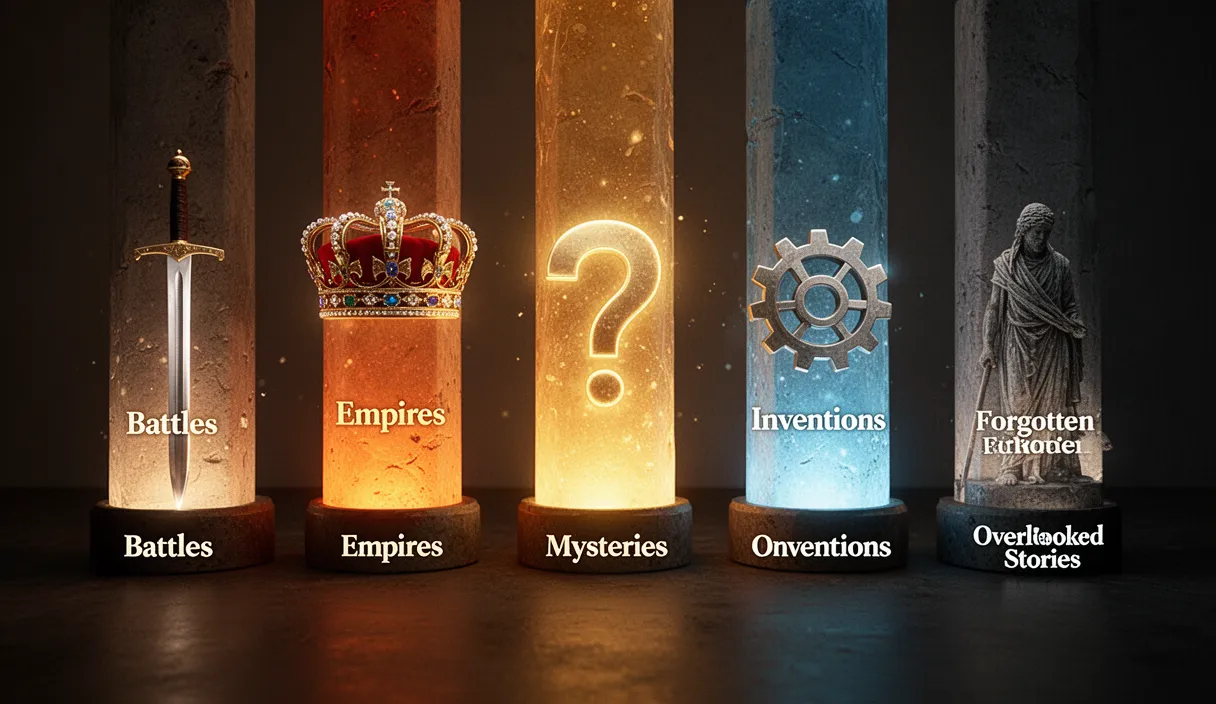
Not all history topics perform equally on social media. The highest-performing categories share a few characteristics: they involve conflict, mystery, or dramatic human stakes. Battles and military campaigns consistently rank among the top history content because they have clear narratives with tension and resolution. The rise and fall of empires appeals to viewers who enjoy grand-scale storytelling. Unsolved historical mysteries -- like the disappearance of the Roanoke colony or the identity of Jack the Ripper -- drive exceptional engagement because viewers debate in the comments. Invention and discovery stories work well because they connect the past to the present in relatable ways. When selecting topics, search YouTube and TikTok for existing videos on the subject. If similar videos have strong view counts, that validates demand. If you can find an angle or detail that existing videos missed, you have a competitive advantage. Maintain a running list of at least 50 topics so you never face a content drought.
Top performing categories
Battles and Military Campaigns
Example topics:
- Battle of Thermopylae
- D-Day
- Siege of Constantinople
Avg engagement: High views, strong watch time
Rise and Fall of Empires
Example topics:
- Roman Empire collapse
- Mongol conquests
- Ottoman Empire peak
Avg engagement: Very high views, binge-watch series potential
Unsolved Mysteries
Example topics:
- Roanoke colony
- Voynich manuscript
- Bermuda Triangle
Avg engagement: Highest comment and share rates
Inventions and Discoveries
Example topics:
- Printing press impact
- Penicillin discovery
- Internet origins
Avg engagement: High shares, broad audience appeal
Overlooked Figures and Events
Example topics:
- Mansa Musa's wealth
- Sybil Ludington's ride
- Great Emu War
Avg engagement: Strong engagement from novelty factor
Writing Historically Accurate Prompts for AI Video
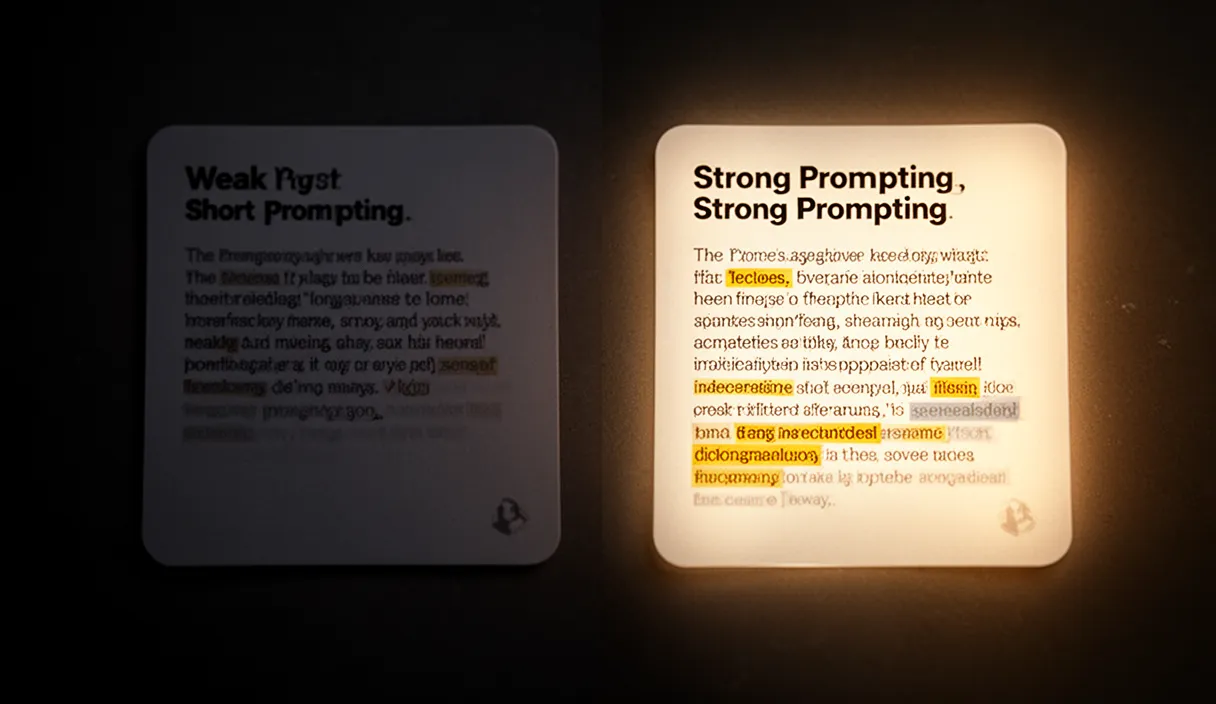
The quality of your AI history video depends entirely on the quality of your prompt. A vague prompt like 'make a video about Ancient Rome' will produce generic content that no one shares. An effective prompt specifies the exact event, time period, key figures, dramatic arc, and visual style. Start with research: spend 15 to 30 minutes reading about your topic from reliable sources like academic summaries, encyclopedias, or well-cited Wikipedia articles. Identify the specific dates, names, locations, and turning points that make the story compelling. Then structure your prompt with a clear narrative arc: set the scene, introduce the conflict or central question, build tension through key events, and deliver a resolution or reveal. Include visual direction in your prompt by mentioning specific settings, time periods, and atmospheric details. For example, instead of 'Roman soldiers,' write 'Roman legionnaires in bronze armor marching through the dusty plains of Gaul at dawn.' FrameSurfer will use these visual cues to generate more specific, historically grounded imagery for each scene.
Prompt examples
Topic: Fall of Constantinople
Weak prompt: Tell the story of Constantinople falling.
Strong prompt: Tell the dramatic story of the Fall of Constantinople on May 29, 1453. Begin with Sultan Mehmed II's massive army of 80,000 surrounding the ancient city, defended by only 7,000 men under Emperor Constantine XI. Describe the 53-day siege, the massive Ottoman cannons that shattered the legendary Theodosian Walls, the ingenious transport of ships overland to bypass the chain across the Golden Horn, and the final desperate battle where Constantine XI charged into the Ottoman lines and was never seen again. End with how this single day ended the 1,500-year Roman Empire and changed the course of world history. Use epic, cinematic visuals of medieval siege warfare and the grand architecture of Constantinople.
Topic: Library of Alexandria
Weak prompt: Make a video about the Library of Alexandria.
Strong prompt: Tell the tragic story of the Library of Alexandria, the greatest repository of knowledge in the ancient world. Founded by Ptolemy I around 300 BC, it housed an estimated 400,000 scrolls containing the collected wisdom of Greek, Egyptian, Persian, and Indian civilizations. Describe the scholars who worked there, including Euclid, Archimedes, and Eratosthenes who calculated the circumference of the Earth. Cover the multiple incidents that contributed to its decline -- Caesar's fire in 48 BC, religious conflicts, and the eventual destruction. Reflect on what humanity lost: works of science, philosophy, literature, and mathematics that were never recovered. Use visuals of grand ancient Egyptian architecture, scholars studying scrolls, and the devastating fires.
Using FrameSurfer to Create History Videos
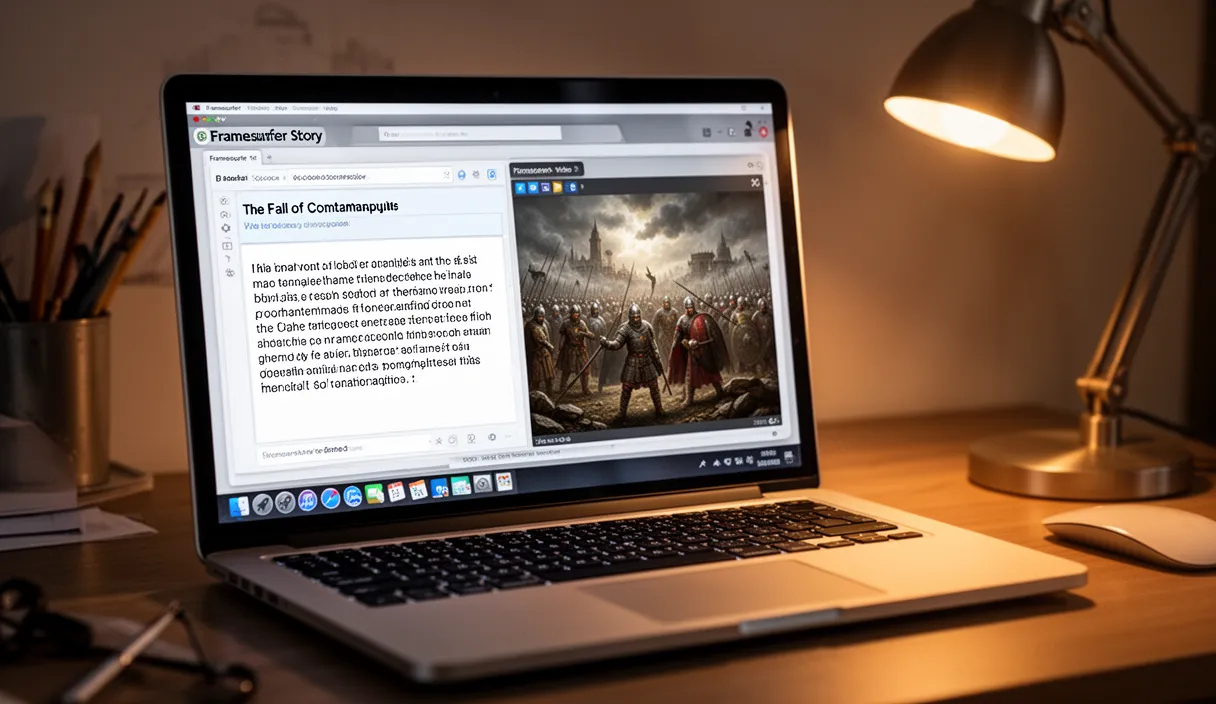
FrameSurfer's Story Video tool is particularly well-suited for history content because it handles the three elements that make history videos compelling: dramatic visuals, authoritative narration, and clear text overlays. To create a history video, open the dashboard and select the Story Video tool. Paste your detailed prompt into the description field. For YouTube content, set the aspect ratio to 16:9 and duration to 2 to 5 minutes for more in-depth coverage. For TikTok or YouTube Shorts, use 9:16 at 60 to 90 seconds. Select a narrator voice that matches the tone of your content -- deeper voices like Brian or Liam work well for dramatic battles and empires, while a measured voice like Roger suits documentary-style delivery. FrameSurfer will generate scene-by-scene AI visuals based on your prompt, synchronize the voiceover narration with automatic captions, and apply transitions between scenes. Review the generated video and make adjustments to individual scenes if needed using the editor. For series content, maintain a consistent visual style by using similar prompting language across episodes so your channel develops a recognizable look.
Workflow steps
- Research your topic thoroughly using reliable historical sources
- Write a detailed prompt with specific dates, names, locations, and visual descriptions
- Select the Story Video tool and set your format (16:9 for YouTube, 9:16 for Shorts/TikTok)
- Choose an appropriate narrator voice and set the duration
- Generate the video and review each scene for accuracy and visual quality
- Make any scene-level adjustments in the editor
- Export and upload with an SEO-optimized title, description, and thumbnail
Building a History Channel: Growth Strategy
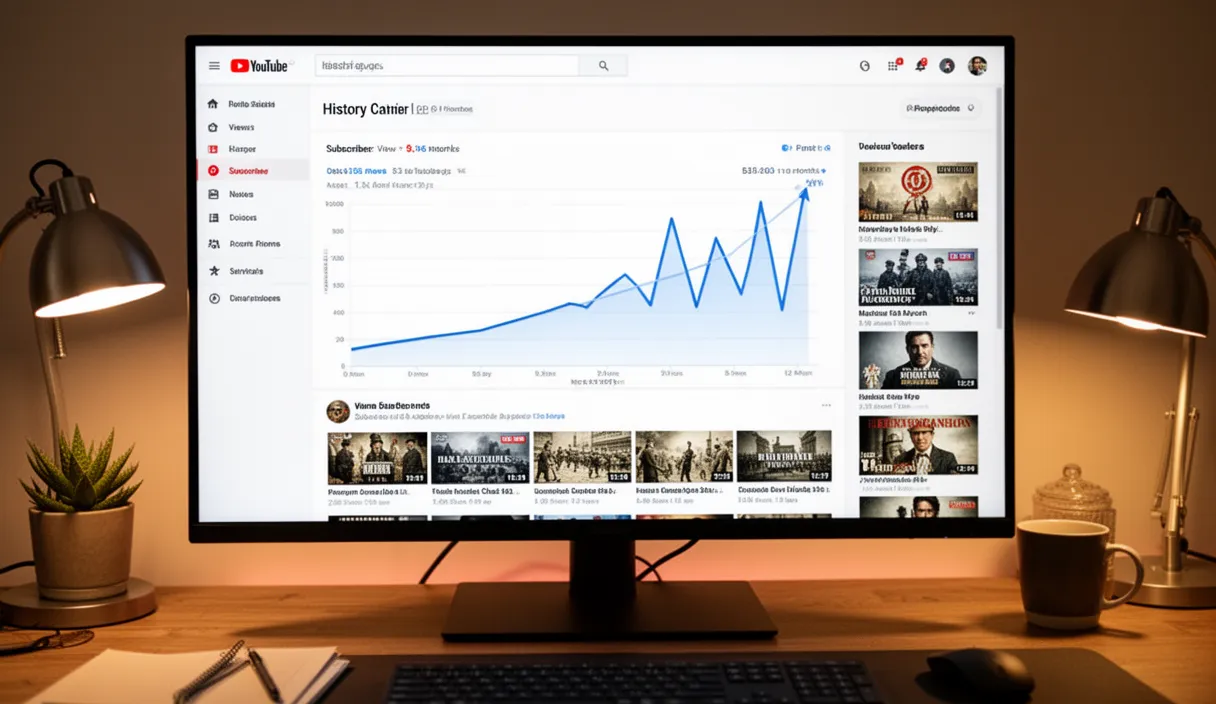
The most successful AI history channels treat their content as a series rather than isolated videos. Pick a broad theme -- such as ancient civilizations, medieval warfare, or the history of inventions -- and build a library of interconnected content within that theme. This creates a binge-watching effect where viewers who discover one video naturally click through to related ones, dramatically increasing your total watch time and subscriber conversion rate. Organize your content into playlists and reference other videos in your narration: 'as we covered in our video on the Roman Republic' gives viewers a reason to explore your back catalog. For SEO, target specific long-tail keywords like 'what really happened at the Battle of Thermopylae' rather than competing for broad terms like 'ancient Greece.' Upload on a consistent schedule -- at minimum twice per week for YouTube, daily for TikTok -- so the algorithm and your audience know when to expect new content. Engage with comments by answering history questions and taking topic suggestions, which builds community and gives you validated content ideas. Cross-promote your YouTube content on TikTok with shorter cuts, and direct TikTok viewers to your YouTube for the full deep-dive versions.
Conclusion
History content has a rare combination of massive audience demand, evergreen relevance, and infinite subject matter. What previously required animation teams and months of production can now be accomplished with careful research, well-crafted prompts, and AI video generation tools. The creators who will build the next generation of popular history channels are not necessarily professional historians -- they are storytellers who know how to make the past feel vivid, dramatic, and relevant. FrameSurfer gives you the production capability. The thousands of years of human history give you the content. The only remaining ingredient is your commitment to showing up consistently and telling these stories well.
Frequently Asked Questions
How historically accurate are AI-generated history videos?
The historical accuracy depends entirely on your prompt and research, not the AI tool. FrameSurfer generates visuals and narration based on what you provide, so the accuracy of your script determines the accuracy of the video. Always research your topics using reliable sources before writing prompts, and fact-check specific dates, names, and events. The AI visuals will be stylized interpretations rather than photographic recreations, which is standard for history content.
Can I monetize AI history videos on YouTube?
Yes. AI-generated history content is eligible for YouTube monetization through the YouTube Partner Program. History channels often have above-average CPM rates because the audience skews toward educated adults, which advertisers value. Channels producing consistent AI history content can realistically reach monetization thresholds within three to six months of regular uploads.
What is the ideal length for a history video?
For YouTube long-form content, 5 to 12 minutes hits the sweet spot -- long enough for the algorithm to serve mid-roll ads and for viewers to feel they learned something substantial, but short enough to maintain completion rates. For YouTube Shorts and TikTok, 60 to 90 seconds works best for single-event stories. For complex topics like the fall of an empire, consider breaking the content into a multi-part series.
How do I avoid copyright issues with history content?
AI-generated visuals and narration are original content, so you do not face the copyright challenges that come with using archival footage, photographs, or documentary clips. Historical facts themselves are not copyrightable. However, avoid narrating directly from copyrighted books or documentaries. Use multiple sources for your research and write your prompts in your own narrative style.
What history topics should I avoid?
Avoid topics that could violate platform community guidelines, particularly graphic depictions of atrocities, content that glorifies violence, or events that are still politically sensitive in ways that could be seen as promoting hate. Most historical topics are fine when presented educationally and respectfully. When covering difficult history like wars or persecution, focus on the human stories and lessons rather than graphic details.